Book A Star Tour Now

book now

Translate

Wednesday, December 8, 2010

Getting a "Crikey"!

We hosted a lovely pair of families from Bet Shemesh this evening, originally from Australia and England: seven boys and two sets of parents. Alot of maleness. I don't consider my job complete until I get at least one "Wow!" from everyone. Tonight I got one better with a "Kreike" from the Australians (or was it the Brits? It was too dark to tell.)!

It is a measure of how much we've lost when the first "Wow" of the evening comes from just seeing a really dark sky full of stars. It really is a "Wow" experience, now had all too rarely because of nearly ubiquitous light pollution. Even before becoming dark adapted, people looking at the sky from the dark skies around Mitzpe Ramon usually exclaim, as in "2001" (or was it "2011"?), "It's full of stars."

There was quite a bit of atmospheric scintillation, so the rising of Sirius, the brightest star in the heavens, was itself a great light show with the star twinkling almost every color of the spectrum, even green. We also saw quite a few early meteors from the Geminids, scheduled to peak on December 13-14, which may herald a good show this year, except inclement weather is being predicted for Israel then.

So, what was the "Crikey" experience of the night? It was the Double Cluster in Perseus, my favorite deep sky cluster, with literally thousands of stars filling the eyepiece of even a small telescope.

"Crikey," it's the Double Cluster in Perseus. 
Credit: Roth Ritter, Dark Atmospheres.
(Click for full-size image.)

We were cold and tired by the end of the evening, but I managed to round up a few of the group for this photo.


Emma and Yoel captured this picture of me showing the business end of the early vintage William Optics 4" refractor to the group.

Enhanced by Zemanta

Friday, December 3, 2010

Cleaning the 40 Inch Mirror of the Wise Observatory Reflector - Part II

L1060696The 40-inch (40") main mirror of the Wise Observatory telescope in Mitzpe Ramon is cleaned about every six months. It is given a new aluminum coating about every two years, depending on conditions. The secondary mirror is cleaned much less often since its face is not directly exposed to the dust and dirt of the desert.

Technical Director Ezra's procedure for cleaning the 40-inch (40") mirror is as follows:

Rinse with distilled water -> rinse with tap water -> wash gently with detergent -> rinse with distilled water -> rinse with reagent grade ethanol -> drag dry with optical cloth -> touch up blemishes that can scatter light

Step 1:
Shai washes the surface of the mirror with distilled water as Ezra looks on.


Step 2: 
Ezra hoses down the mirror with tap water as Yevgeny and Matan look on.

Step 3:
Ezra carefully cleans the surface of the mirror with regular dish detergent and a sponge made of surgical cotton wrapped in TexWipe's TechniCloth III. Only the weight of the wet sponge itself is allowed to bear down on the mirror.

The cleaning cloth holding the surgical cotton is TexWipe's TechniCloth III

Ezra's choice of cleanser.
Step 4:
Shai rinses the mirror with distilled water while Yevgeny and Matan spin it.

Step 5:
Ezra purges the surface of the mirror with ethanol, while the team points out areas that need attention.

Step 6:
Ezra swipe dries the alcohol from the surface of the mirror.
Step 7:
Ezra touches up chips on the mirror edge with black marker to reduce scattered light.

A chip in the mirror's edge, blackened with marker to reduce scattered light. The mirror was delivered with this edge chip. It has a negligible effect on performance, but amateurs would never accept a mirror with such a large blemish on their much smaller optics. Of course an amateur mirror only costs a few thousand dollars and a few days to replace. Not so a large observatory mirror.

From left: Ezra, Matan, Yevgeny and Shai view their finished work.

The clean, 40" mirror is covered while the team takes a break before reversing the procedure to remount the mirror.

Saying goodbye, a stark desert of dust and rock, waiting to re-coat the mirror, surrounds the observatory on all sides.

L1060760
Goodbye for now to the Wise Observatory.

Thank you for allowing me to observe and photograph the cleaning of the 40" mirror.

(Cleaning the 40" Mirror - Part I)

Addendum:
Some folks on the Cloudy Nights astronomy forum wanted to know what it took to clean a really big mirror. This photo was posted in response.

Cleaning a REALLY BIG telescope mirror.

Enhanced by Zemanta

Wednesday, December 1, 2010

Cleaning the 40 Inch Mirror of the Wise Observatory Reflector - Part I

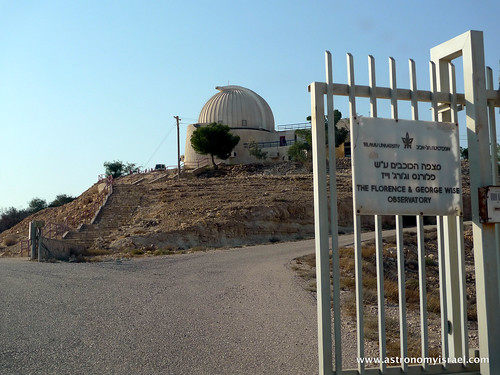
Through the kindness of my friend Nachliel who works at Tel Aviv University's Wise Observatory in Mitzpe Ramon, I was given permission to observe and photograph the cleaning of the 40 inch (40") mirror of the Ritchey-Chretien reflector at the observatory last Sunday. While not huge by today's standards, the telescope is still a substantial research instrument and is used in leading edge research such as the search for earth-like exo-planets. It was very exciting to be so close to the big scope and learn the details of what holds it together as it was disassembled to remove the main mirror. It was also a chance to learn the mirror cleaning techniques of Ezra, the observatory's long-time technical director.

The telescope and observatory were inaugurated in 1971. It's first finding was a comet in 1972 that was actually discovered by an Egyptian astronomer since all of the Jewish astronomers had been called up to do battle in the 1972 Yom Kippur War with Egypt!


When I arrived the telescope was in its parked position and Ezra, the technical director, Shai, and students Matan and Yevgeny were preparing to remove the instruments on board the telescope.

The 40" reflector in its parked position. (Click for full size images.)

All of the telescope's motions are now controlled by computer, but in the old days this analogue console was used to operate the telescope and control its tracking of the stars.


Yevgeny at the old analog console.

The first order of business is to remove the digital camera, custom made by the Planck Institute in Germany. The camera and telescope have an actual field of view of 1 square degree, about twice the apparent size of the full moon, which is huge for an instrument this size.

The digital camera is unbolted, lowered, and moved aside.

With permission, I quickly scurry over to the telescope where I snap this self-portrait looking up the open optical tube. My reflection is seen in the hyperbolic secondary at the top, which in turn can be seen reflected in my camera lens.

The winch is made ready to lower the 2 ton mirror to the work floor below the observatory.

The trap door in the observatory floor is removed to give access to the work room about 50 feet below.

After removing the metal plates that hold it to the telescope, the Ritchey-Chretien corrector plate is removed from the bottom of the telescope tube. (Note: A Ritchey-Chretien has no corrector plate, just two hyperbolic mirrors, so I don't know what this plate was for.)

This is one dirty corrector plate. Note all of the dust and the bird feather at 3:30.

The corrector plate is set aside to be cleaned later with the mirror. (Perhaps a field flattener?)

Everyone now turns their hand to removing the heavy metal plates that secure the mirror mount to the telescope tube.

The telescope tube and dome seen through the trap door from the lower work floor.

The dolly for moving the mirror is now raised into position beneath the mirror mount to receive the mirror when the observatory floor is lowered.

The 2 ton mirror is deposited on the dolly and wheeled away from the telescope tube.


Our first sight of the mirror in its cell...and it is extremely dusty!

For those of you afraid of working close-in with metal tools around a mirror, Ezra is seen at the top right using a screw driver to remove one of the three mirror clips holding the mirror to its cell.

Up up and away. The mirror is lifted clear of the cell and swung around to the trap door...

...where it descends into the work area below.

The mirror is deposited into its custom-made plexiglass bathtub.

Elapsed time to this point: Approximately 3 hours.
To be continued. Next post - cleaning the mirror.

Enhanced by Zemanta

Friday, November 26, 2010

Interesting Atmospheric Phenomena Continue in the Desert

We continue to have interesting skies in the day time around Mitzpe Ramon. On Thankgiving day we had beautiful mares' tail cirrus in the sky for most of the day.

Mares' tail cirrus above the Visitor Center in Mitzpe Ramon. (Click for full size image.)

Detail of mares' tail cirrus clouds

Earlier in the week we had mackerel skies at dusk. Both of these cloud formations, mares' tail clouds and mackerel skies, are indicative of unstable weather and storms ahead, hence the folk saying: "Mackerel scales and mares' tails make lofty ships carry low sails", in anticipation of the great clippers of yore having to lower their sails in a storm.

Mackerel skies above Mitzpe Ramon. (Vega is the bright star at top center.)


But all of Israel continues in a drought, with no storms following in the wake of these clouds.
Enhanced by Zemanta

Thursday, November 25, 2010

"A World So Full of Wonder and Grace..."

On this Thanksgiving Day, Astronomy Israel gives thanks for its friends in America and America its friend.

I was reading about this home planetarium, when I came across one of the most poignant reviews I have ever read that reminded me just how wonderful our universe is, and how simply glad and thankful it made me to be alive in it today:
i got this for a family member near death , with cancer. weak from his illness and having to stay in bed all the time. i thought that the celing was not to be the last thing he would see before leaving this world, a world so full of wonder and grace.
he loved it ,and used it until.......
"Two things cause wonder the more often we contemplate them: the starry sky above us and the moral law within us." -- Immanuel Kant

Defenceless under the night
Our world in stupor lies;
Yet, dotted everywhere,
Ironic points of light
Flash out wherever the Just
Exchange their messages:
May I, composed like them
Of Eros and of dust,
Beleaguered by the same
Negation and despair,
Show an affirming flame.
--W.H. Auden, "September 1, 1939"


Enhanced by Zemanta

We Welcome Rebecca and Yair

We welcomed Rebecca and Yair from Tel Aviv to our "observatory in the hills" above Mitzpe Ramon. We had a beautifully clear night with temperatures in the high 50s (F). We began early, around 6:00 PM, to get some dark sky observing in before the 17 day old moon rose at 8:00.

After a quick tour of the night sky with green laser pointer we set our sights on the beautiful Double Cluster in Perseus, followed by M31 in Andromeda. We anticipated where the moon would rise and got a spectacular view of it in the telescope as it rose above the hills in the east, seeing it as a great yellow egg outlining the hills in the foreground. We saw the gem-like double star Alberio and then moved on to Jupiter, the King of Planets. Switching to the moon I decided to try out the bino-viewer and we were treated to a great space-walk view of the lunar surface in 3D. At that point I couldn't resist training the scope with bino-viewer on Jupiter. It looked like a painted ping-pong ball hanging in space. It truly is much easier to see planetary detail with two eyes rather than one.

We shared hot drinks and marveled at how bright the moon is when it rises into a truly dark sky. That's why the Indians never attacked the fort during a full moon! Since our observing location is near the edge of the Machtesh, we wandered over to the unprotected rim where we got a good view of the giant crater by moonlight.

Rebecca at the helm of the 4-inch William Optics refractor.

Rebecca immediately took to operating the focus and slow motion controls of the telescope. I think she will soon need her own!

Thank you, Yair and Rebecca, for allowing us to take you on a tour of the night sky from Mitzpe Ramon.

Enhanced by Zemanta

LinkWithin

Related Posts Plugin for WordPress, Blogger...