The peak night of the Perseids Meteor Shower in 2024 is August 12 which is Tisha B'Av this year. There is also a waxing moon which gets bigger and brighter every night after new moon on the 6th. Its bright light blocks the light of dimmer objects like meteors. The moon sets before midnight up to the 12th but one hour later each night thereafter. Starting August 13 the moon is first quarter and starts getting quite bright, blocking the light of dimmer meteors. Best viewing of the meteor shower is after midnight. Most families don't stay through the wee hours of the night but you are welcome to.
The radiating effect of meteors all originating from a single location in the sky called the "radiant". In the case of the Perseids Meteor Shower from the constellation Perseus, the hero who rescued Andromeda.
So what will you see? On a typical year on the peak night many meteors. You probably read numbers of 60-100 per hour, making this one of the best meteor showers of the year. But honestly I have only seen that many once in my life from Mitzpe Ramon. Off peak, which is about 2:00am on the morning of August 13 (Tisha B'Av this year), there are still many more meteors seen than on the average night (maybe 1-2 during a 2 hour star tour, maybe none) but nothing like the peak. The more days off the peak the fewer number of meteors. In addition the waxing moon starts to interfere after August 13.
As you can see, the peak of the Perseids is very steep, rapidly falling off on either side of the peak on the early morning of August 13.
We will not be going out on Tisha B'Av, so the best time to view on our star tour is August 6 (new moon) through August 11. The closer to August 11 the better.
This year Mitzpe Ramon turns off its lights on August 11, although we go into the Ramon Crater to observe. August 13-15 are good but because of the waxing moon not as good as August 6-11. August 11 is the best alternative to August 12.
If you would like to see an animation of the way the Earth's orbit intersects the debris trail of Comet Swift-Tuttle, which creates the Perseids Meteor Shower, click here. The Earth's orbit is blue: https://www.meteorshowers.org/view/Perseids
The most popular place to view the meteor shower is the Ramon Crater but literally tens of thousands of people come there on a good year. Well known dark locations are usually crowded everywhere.
With Chanukah🕎 approaching the Festival of Light will not affect dark skies in Mitzpe Ramon. The candles will blaze bright but we will still have our dark skies. Take a little time to star gaze with Astronomy Israel and /Ira Machefsky, the Starman of Mitzpe Ramon™ 💫. We will have star tours at 6:30pm every night of Chanukah (7:30pm on motzei Shabbat), December 9-18.
This is the week of the peak of the Geminids meteor shower which puts on the best display of the year. Many shooting stars explode like fireworks at the end of their fall. Perfect for Chanukah. See if you can count at least 8! Peak night of the meteor shower is December 14-15 but is usually well seen throughout the week. Also featured will be the best telescopic views of Jupiter and Saturn. Come see Saturn before the rings turn edge on next year and disappear for 18 months. 😢
Star tours are suitable for all ages and are handicap friendly.
Star tour shenanigans will include light saber duels (what could be better on Chanukah), 2100 year old Chasmanoyim chocolate Chanukah gelt and a specially minted double flag Astronomy Israel/Israeli flag commemorative pin. (One per family until stock runs out.)
The peak of the Perseids Meteor Shower will occur on the nights of August 12 and August 13, 2023. The predicted peak is between the hours of 10:00AM IDT - 5:00PM IDT on August 13, daylight hours in Israel. So the night of Saturday August 12 and Sunday August 13 are equally good for peak observing.
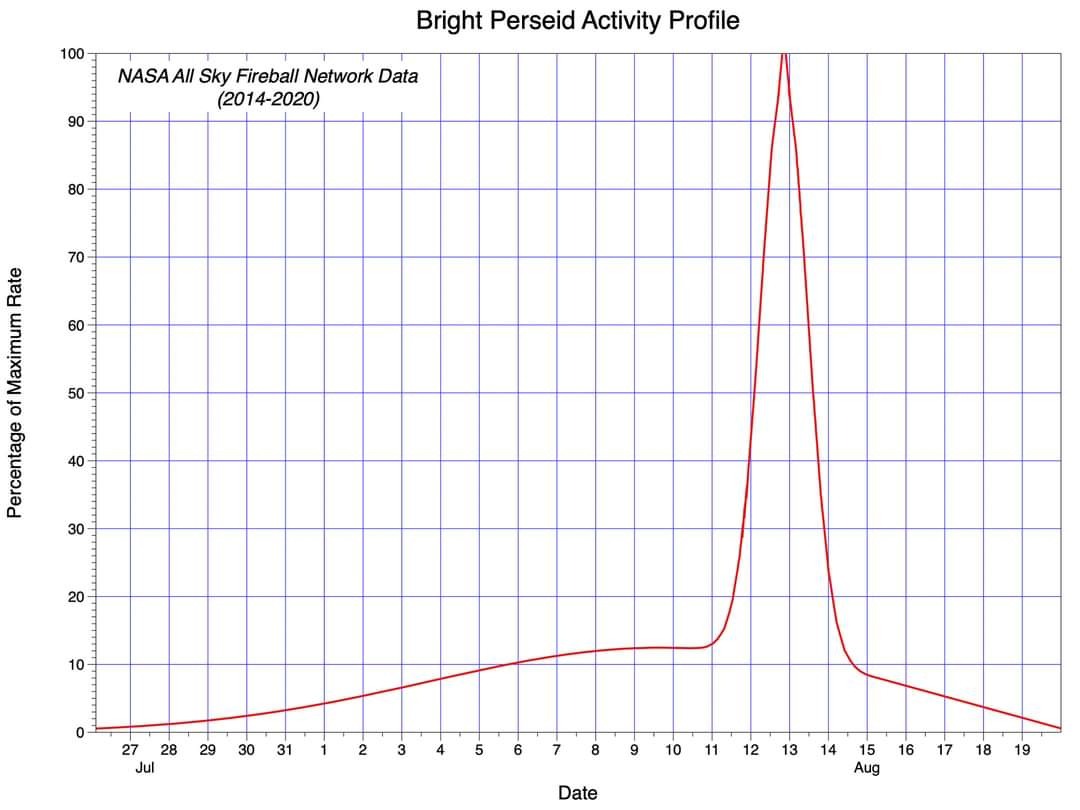
For people who can't make it on peak nights I always am asked what will the shower look like on nights either side of the peak. The Perseids has a very sharp peak on a single night of 100 meteors per hour. On nights off peak the rate quickly drops to 1/10th that, around 10 meteors per hour. (See graph below.)
The x-axis shows dates of the month, the y-axis shows zenithal hourly rate (ZHR), which is the theoretical maximum number of meteors you can see per hour lying on the ground, staring straight up, and looking in all directions simultaneously. This chart gives the average numbers from 2014-2020. As you can see, the numbers fall off rapidly away from the peak. Nevertheless, experience shows that the Perseids do not disappoint around 5 days before and 5 days after the peak, while not putting on as good a show as the peak night.
Best viewing is always after midnight, and this year there is a very tiny, waning crescent moon rising at 2:00AM on the 12th and about an hour later on each succeeding night, so it will not pose a problem.
The Perseids has become a phenomenon and this year there are many programs, star parties, and star shows in and around Mitzpe Ramon. As they are mostly in Hebrew search for them on social media in that language or search engines in that language.
I will have my own star tours the week before and after the peak, but not on the night of the peak, August 12. In past years over 30,000 people have descended on Mitzpe Ramon for the peak night. Traffic can be jammed up on Rt 40 all the way back to Be'er Sheva. So, check Waze before heading down to see what your drive time will be. Because of all the people, cars, noise, camp fires in and around town I choose not to go out on the night of the 12th. I will be having my star tours on all other nights except Shabbat. To get information and book a tour: https://www.bookeo.com/astronomyisrael
If you do not already have accomodations reserved you will probably find them all sold out. Check for them on this web site at the Places To Stay tab.
A partial lunar eclipse will be visible in Israel the night of Tuesday, July 16. Israel is nearly ideally placed for the timing of the eclipse whose partial phase begins at 11:01PM IDT. Maximum partial eclipse is at 12:30AM July 17, when a little over half the moon will be eclipsed. The partial eclipse ends at 1:59AM on July 17.
The moon orbits the earth, moving from west to east in the sky. As it does so on the night of July 16 it passes through the earth's shadow. A little over half the moon will become covered at mid-eclipse.
Astronomy Israel will be having a lunar eclipse party starting at 10:30PM the night of July 16 with special party pricing of 100nis/adult, 75nis/child between 6-12 years old, no charge under 6.
A lunar eclipse occurs only when the moon is full, so it will be very bright and visible from almost anywhere in Israel. (Unfortunately for the Americas, the eclipse will be over before moon rise there so not visible to enthusiasts there. Come to Israel to see it!!) So, unlike many astronomical events that require a dark sky, you will be able to see it from wherever you are. (Do I have to tell you how to find the moon?) Nevertheless, we are having an eclipse party in Mitzpe Ramon beginning our regular star tour at 10:30PM on July 16 instead of 9:30PM, half an hour before the partial phase begins. We will be able to watch the eclipse through our telescopes and binoculars, point out features on the moon visible only through telescopes, and look for the Apollo 11 landing site, only 4 days before the 50th anniversary of the first manned landing on the moon of July 20, 1969.
This is the last umbral lunar eclipse, where the moon passes through the dark part of the earth's shadow, until May 26, 2021. All of the four lunar eclipses in 2020 are penumbral eclipses, which are hardly visible even as they occur, so be sure to go out and watch it.
Lunar eclipse timings for Israel, July 16-17, 2019
Comet 46P/Wirtanen, the brightest comet of 2018, puts on a good show in winter skies this month. It is well placed for viewing through most of the night. It should be visible to the naked eye in reasonably dark skies and with even small binoculars or a telescope in even light polluted skies. Below is a finder chart showing the stars and constellations of winter from December 13-17.
Comet 46P/Wirtanen finder chart for December 9-17. The comet is about 4th magnitude and slowly moves through the sky between the Hyades star cluster and the Perseids star cluster December 14-17. It is brightest on December 16, the night before its closest approach to Earth.
December 13 is the peak of the Geminids meteor shower, so the sky should also be putting on a good display of meteors for your enjoyment.
Astronomy Israel will be having its usual star tours in Mitzpe Ramon Sunday-Thursday and some Saturday nights throughout the month of December and beyond. Sign up by clicking a "Book Now" button.
Well, the Perseids have come and gone for the year. The night was beautifully clear and dark. One of the best I have seen this year. The Alpaca Farm set up a wonderful location for the star party, dark skies and plenty of space to sit or lie down and watch the sky. About 100 people, including children, were in attendance. Ziv lead the Hebrew tour and I led the English tour. We were out from about 8:00pm to 3:00am. The meteor shower got off to a slow start, and we didn't start seeing lots until after midnight. But then the show picked up and we were sometimes seeing several every 10 seconds. But meteors fall in bursts, not continuously. I don't think we ever reached the maximum rate of 100 per hour but around 2:00am, near the peak time, we were probably averaging around 30 per hour. Most were short, bright bursts of light.
I held my meteorite raffle lots more than once per hour, and many happy people went home with their own meteorites. I'm already looking forward to next year's show. In the mean time stay tuned for the next star party on December 13 (Thursday night) when the King of the Meteor Showers, The Geminids, peaks.
The best meteor shower of the year, the Perseids, peaks this year (2018) on Sunday night August 12 into early Monday morning August 13. The shower has peak rates of over 100 meteors per hour, and since it occurs in the warm summer months is a popular summer star gazing activity. To help celebrate the event Mitzpe Ramon is turning off all its town lights after 10:00pm and hopefully the other lights from military bases in the area to create an especially dark sky. The darker the sky, the more meteors we see. Mitzpe also holds a town star party which this year will be located in the Machtesh to avoid over crowding the town with the thousands of people who usually come to see the event. During the day up to 20:00 there will be various astronomical events and free lectures around town. Details here. Hotels fill up quickly so if you are coming you should reserve your rooms immediately.
Astronomy Israel will be having its own star party on August 12 with special star party pricing of 75nis/person over the age of 6, no charge under 6. This is a big discount from our regular star tour prices, but we want every one to be able to come and enjoy the show. We will be out most of the night from dusk until whenever. This is an especially good year for the Perseids since there is no moon in the sky, as the moon is new on Sunday night and sets with the sun. A bright moon severely interferes with seeing the dimmer meteors in a shower. This year we will be doing both Hebrew and English tours of the night sky during the star party, with my co-pilot Ziv handling the Hebrew tour.
We are pleased to be holding this year's star party in conjunction with the Alpaca Farm of Mitzpe Ramon who will be hosting the star party and providing camping accommodations to guests. They will also be selling drinks, snacks and, food. Camping at the Alpaca Farm is 120nis, including Alpaca Farm entrance fees. (Bring your own sleeping bags and tent, the Alpaca Farm is just providing the space.) A super-special discount for the star party: 25nis/person (6 years old and up, no charge under 6) if you sign up for the star tour together with camping at the Farm. Contact the Alpaca Farm to arrange for camping with them, not me. Mention the star party if you want to sign up for the special Alpaca Farm star party price. Those staying elsewhere should sign up directly for the star party at my booking site. The cost is 75nis/person (6 years old and up) if you are staying elsewhere. No entrance fee to the Farm if you book the star party directly at my booking site. To contact the Alpaca Farm:
Phone: +972-52-897-7010
Email: office@alpaca.co.il
Web site: www.alpaca.co.il
The Alpaca Farm is just 5 minutes behind Mitzpe Ramon, down Ben Gurion Boulevard, the main road into Mitzpe Ramon.
To book the star party directly if you are staying elsewhere, click the button below:
Meteors are what most people call "shooting stars" or "falling stars", but they are neither. They are bits of rock and debris from outer space that fall to earth and burn up from the heat of friction with the earth's atmosphere. It's their light generated by friction with the earth's atmosphere that we see. Usually these rocks from space just fall randomly so we only see a few per night. But sometimes the earth passes through the orbit of an ancient comet, which disintegrates as it orbits the sun and leaves a debris trail behind. As the earth passes through this cometary debris trail scores of particles fall to earth simultaneously creating a meteor shower. Really good showers like the Perseids can have peak rates in excess of 100 meteors per hour. Of course most of these are quite dim, but many bright ones are also visible creating "Ooohs" and "Ahhhs" from the onlookers.
As the earth passes through the orbit of an ancient comet debris rains down of our planet creating a meteor shower.
Israel is ideally placed this year to view the shower as the peak falls during the early morning hours of August 13 in this part of the world. Meteor scientists are also predicting a mini-peak around 11:00PM on August 12 as the earth passes through a small stream of particles left behing by Comet Swift-Tuttle, the comet that is the origin of the debris that makes up the Perseids Meteor shower. Make sure to be out by then.
Most meteors are quite tiny, minuscule even, about the size of a grain of sand. Of course, we don't see an object that small in the sky, we just see the tremendous light generated as they burn up from friction. They begin to become visible at heights of around 50 miles to 175 miles high. But sometimes enormous objects fall to earth. Most recently the Great Chelyabinsk Meteor fell to earth on February 15, 2013, over the town of Chelyabinsk Russia. It was 60 feet in diameter and weighed over 12,000 tons when it entered the earth's atmosphere at a speed in excess of 100,000 MPH. It was the largest meteor to fall to earth in over 100 years and was captured by numerous dashboard cameras. I put together a compendium of the videos on YouTube, and it is one of the most dramatic astronomical events of recent memory:
If meteors are large enough they can survive their fiery fall through the earth's atmosphere and hit the ground, as the Chelyabinsk Meteor did. They then change their name to meteorites and can be found, collected and researched. They are primordial pieces of the solar system, over 4 billion years old. As usual I will have my large bag of magic "rocks from space" with me, and you will be able to hold real "shooting stars" in your hand. Also, as usual, we will be raffling off free meteorites every hour (retail value 50nis), and Yes, if you don't win one and really want to take one home we will sell them to you if you insist.
Two of the meteorite pairs we will be raffling at the star party: A Tektite (left)) and a fragment of the Campo del Cielo (right).
Meteors can be observed from any dark sky location and no optical equipment is needed or even desirable. They can appear anywhere in the sky so the best place to see them is a dark sky location with open horizons. Just lie down on the ground and look up. That's why Mitzpe Ramon is such a popular location for viewing them. People often ask me where is a dark sky location besides Mitzpe and my answer is, "I don't know." I do almost all my observing from Mitzpe. You know your own area better than I do.My impression is that in the center of the country along Route 35 and 38 there are a number of parks where the sky may be suitably dark, but I've never observed from there myself.
If you trace the path of meteors in a shower back from their source they appear to emanate from a single location in the sky, a particular constellation, called the "radiant" of the shower. The Perseids appear to emanate from the constellation Perseus, just below Cassiopeia. as the radiant rises higher in the sky more meteors are seen. That happens after midnight in August which is why the early morning hours are usually the best for viewing the meteor shower.
Time lapse photo of meteors appearing to emanate from the "radiant" in the constellation Perseus.
Although the peak of the shower is very sharp there is also a great increase in the number of meteors a few days before and a few days after the peak. This chart is an illustration of the the prediction of the rates for the shower in 2016:
Predicted Zenithal Hourly Rate (ZHR) of the Perseids in 2016
As you can see from the above chart while the peak is quite sharp, which is why people try to come on the night of the peak, these is still quite an uptick in meteors 3-4 days before and after the peak and sometimes even longer than that, with rates in the 30 or so per hour, still far more than are seen on an average night. Of course most of these are quite dim, but there are still a few bright ones, fireballs, that make the night memorable, so it is also worth coming for a look at the shower a few days before or after the peak, although predicting what you will actually see then is impossible. But the sky will still be quite dark as there will still be no bright moon in the sky.
You can book our Perseids Star Party Tour by clicking this button:
The century's longest lunar eclipse is on Friday night July 27, Tu B'Av on the Jewish calendar. And lucky you if you live in Israel because you will have one of the best front row seats. Those living in the Americas and Canada, sorry! The eclipse ends before moon rise in your part of the world. So grab your best guy or gal, get an airplane ticket, and celebrate the Jewish night of romance with them under the totally eclipsed moon in Israel.
The chart below shows the timings and circumstances of the eclipse:
Timings and circumstances of the total lunar eclipse of July 27, 2018
Timings of the total lunar eclipse for Israel, with local Israel Daylight Times in parenthesis. In other words, the lunar eclipse begins at 9:24PM local time on Friday night, July 27, peak darkness is at 11:22PM on July 27, and ends at 1:19AM the morning of July 28.
2018 July 27
Partial eclipse begins: 18:24 UTC ( 21:24 Israel Daylight Time)
Total eclipse begins: 19:30 UTC (22:30 Israel Daylight Time)
Greatest eclipse: 20:22 UTC (23:22 Israel Daylight Time)
Total eclipse ends: 21:13 UTC (00:13 Israel Daylight Time)
Partial eclipse ends: 22:19 UTC (01:19 Israel Daylight Time)
This is such a long eclipse because as you will note from the chart above, the moon passes almost directly through the very center of the earth's shadow, its widest part, spending the longest time of the 21st century in eclipse! This is also a Micromoon full moon, the opposite of a Supermoon. A Micromoon full moon occurs when the full moon is at apogee, its greatest distance from the earth, so it appears smaller in the sky. Hence it also spends more time in the earth's shadow. Aren't we lucky to be alive on this date and living in Israel for a front row seat!
Take some time while watching the eclipse to note the moon's darkness, called its Danjon Number during an eclipse. 0 is darkest, 5 is brightest. When the moon passes centrally through the earth's shadow it's farthest from the edges of the shadow, so less sunlight gets refracted onto its surface during the eclipse. During some very dark eclipses the moon may completely disappear. But this also depends alot on the earth's atmosphere at the time. The denser or cloudier it is around the globe the more sunlight gets refracted onto the moon and the brighter the eclipse. This is hard to predict so it should be fun to look for how dark this eclipse is and estimate its Danjon number. You can find out more about the Danjon Scale here.
All lunar eclipses occur during full moon, when the moon is opposite the sun with the earth in between. July 27th's eclipse falls out on the full moon of the Jewish month of Av, or Tu (meaning 15) B'Av, often referred to as Jewish Valentine's Day, since on this day in ancient times the girls used to dress in their finest and dance in the fields to encourage matches with the boys. A happy time after the fast and mourning of the 9th of Av, Tisha B'Av. So, what could be better than going out with your Bestie to enjoy the romance of the longest lunar eclipse of the 21st century? I will leave it to the astrologers if this is a good or bad omen, the eclipse of the light of love or its revelation in the darkness of the moon. In any case this should not be one of those famous "blood red" moon eclipses since it is so central in the earth's shadow and little refracted sunlight, which causes the red color, should be evident. In any case be sure to take in all the planets that will be visible during the night, and especially during the darkness of totality. (See our previous post on the summer planets.)
You need no optical aid to the view a lunar eclipse but even small binoculars enhance the view and will show you details on the moon that are otherwise invisible to the naked eye.
There are many events being held to view the lunar eclipse in Mitzpe Ramon, but since this is a Shabbat night we will not be holding our usual star tour. You can look those events up online if you want to come down here. But a full moon and eclipse is usually so bright that you should be able to watch it from almost anywhere in Israel from the beaches of the Mediterranean to Diezengoff Square.
When I complained to a friend that the longest lunar eclipse of the century was falling on Shabbat and I wouldn't be able to hold a star tour, he told me, "Relax, it's Gd's way of telling you to just enjoy yourself for once." And so I shall. I hope you do,too!
The Perseids Meteor Shower is visible from July 17-August 24, with a sharp peak of 60-90 meteors per hour on the night of August 12-13. This year the waning gibbous moon will interfere with visibility of the shower as it rises on August 12 at 10:30pm and on August 13 at 11:11pm. By August 15 the last quarter moon rises shortly after midnight giving us a dark sky for the two hours of our star tour from 9:30-11:30pm.
The moon will be quite bright and will interfere with the visibility of the dimmer members of the meteor shower. The brighter members of the shower will still be visible but it's hard to say how many of those will be seen. Add to that the fact that we've had very hazy skies this summer from the Chamsin-like weather we've had and the shower may disappoint this year. As you can see from the shower intensity graph below, the best nights to view the shower, ignoring the moon, are August 11-15.
Intensity of the Perseids Meteor shower, meteors per hour on each day of the shower.
STAR TOURS DURING THE PERSEIDS METEOR SHOWER:
We never have star tours on Shabbat so our first star tour of the shower period will be held on the peak night of the Perseids, August 12 starting at 10:30pm. (We will have our regular star tours the preceding week of August 6-10 at 9:30pm, but that is a full moon week and the bright moon will interfere with viewing all but the brightest members of the shower.) We are usually out for two hours, but if the shower is good we will stay out longer. Star tours from August 13 and onwards will start at our regular time of 9:30pm.
In past years Mitzpe Ramon has held its annual star party on the night of August 12, the peak of the meteor shower, turning off all the town lights and army-base lights in the vicinity. About 9,000-10,000 people used to come to Mitzpe for this event. The town is not doing that this year. Instead the town is hosting astronomy nights during the 4 weekends in August. Special astronomy events will be held in the Spice Routes Quarter of town. Local lights there will be turned off during these 4 weekends. That makes it possible to see the sky from there but does nothing to reduce the overall light from town - a bit disappointing but Mitzpe is still a very dark region of Israel. The problem for this year's Perseids is the waning gibbous moon, not Mitzpe Ramon's town lights.
You don't have to come to Mitzpe Ramon to view the meteor shower. All you need is a dark sky with an open horizon. Just sit back or lie on the ground and look up. Watch the skies with your naked eye. No optical equipment required. While you can watch in any direction, looking east if you can't look straight up, is usually best, as that is the direction the radiant of the shower rises in the constellation Perseus, which gives the Perseids its name.
BOTTOM LINE:
The nights of August 11-August 15 are best for viewing this year's Perseids Meteor Shower. A bright, waning, gibbous moon will interfere with seeing the dimmer members of the shower which will considerably reduce the hourly rate. The nights of August 14 and 15 may be a good compromise between intensity and darkness for early night viewers of the shower. Check the forecast for haze on the nights of August 11-15. Haze combined with a bright moon do not make for good meteor viewing.
Perseids Meteor Shower Update on August 10, 7:10PM
We have been out every night this week. So far, very few meteors observed, maybe 1-2 per hour from 8:00PM to 1:00AM every night. An occasional fireball, a really bright meteor, was observed. The moon has been incredibly bright, and haze has returned to our skies, scattering the moon's light across the sky and making even bright stars hard to see. None of this bodes well for the upcoming peak of the shower on Saturday night and Sunday morning.
Perseids Meteor Shower Update on August 13, 2:45AM
While we don't do a star tour on Shabbat, we did walk out to the edge of the crater on Friday night, August 11, after dinner around 11:00PM. This was the first peak night. The sky was quite discouraging. There was a bright moon hanging in the sky accompanied by high haze. Worse, the crater was full of fog blocking the view of the many people we could see camping from the light of their fires. We didn't stick around for long and saw no meteors while we were out.
Saturday night August 12, the second peak night, we were out after Shabbat by 9:00PM to set up for our star tour. The sky was wonderfully clear. No moon yet and the haze had largely dissipated. Once our star tour began around 10:15PM we saw many meteors. Or should I say I heard them. I'm too busy doing the star tour to always watch they sky. We heard constant "Wows" from our guests until just after the moon broke the horizon at about 11:00PM and for about 30 minutes thereafter. I don't have any actual meteor count, but we were probably seeing on average about one meteor per minute, many of them quite bright and long. It was definitely a shower. As the moon rose higher the meteor count dropped until after around 1:00AM we no longer saw any. We may have been in a temporary lull, the peak may have ended or maybe the moon was just too bright. I don't know. In any case we will try again on Sunday night with a star tour at 9:30PM. It's a day past the peak, but the moon will rise 40 minutes later so we should have a dark sky for almost the entire star tour.
Next year the shower's peak coincides with new moon, so no moon in the sky all night long. Mark your calendars now! August 11, 12, and 13 - Saturday, Sunday and Monday nights. It's the same date every year, folks!
…you were the highlight of our trip to the Negev. I was worried that a two hour plus astronomy talk would be a step too far....but it was truly fantastic and loved by us all. Was sorry when it ended. It is a must for all - you are a STAR man on many fronts.
Having Ira as our guide for the stars was a privilege. He turned our night tour into an unforgettable experience where we could witness falling stars, constellations and planets. He is fun, patience, smart, kind and very kind. We learned a whole lot about the sky, the stars, and about ourselves. It was a fantastic -and musical- experience!
Early in the morning of September 28 a total eclipse of the moon will be widely visible around the world. In Israel the moon begins to enter the penumbra of the earth's shadow at 3:11AM IDT, however the darkening of the moon will probably not be visible until the moon enters the umbra of the earth's shadow at 4:07AM IDT. Totality begins at 5:11AM IDT with mid eclipse occurring at 5:47AM IDT, just before sunrise.
Lunar Eclipse Events, Israel Daylight Time (IDT) 03:11:46 Moon enters penumbra 04:07:12 Moon enters outer edge of umbra 05:11:11 Moon completely in umbra 05:47:09 Mid-eclipse 06:23:07 Moon begins to emerge from umbra, after moon set in Israel 07:27:06 Moon completely out of umbra, after moon set in Israel 08:22:33 Moon leaves penumbra, after moon set in Israel
View to the West with the moon half-eclipsed at 4:31AM IDT
View to the West during totality, just before sunrise at 5:46AM IDT. This should be spectacular over the Mediterranean.
Timing of the circumstances of the lunar eclipse. Add 3 hours to the times shown to get local Israeli time.
This eclipse is notable for a number of reasons. 1) It's the fourth in a series of total lunar eclipses in two years. 2) It occurs when the moon is closest in its orbit to the earth, called the "perigee" of the orbit, and in modern times referred to as a "supermoon", although in reality it will only appear about 15% larger than a regular full moon in the sky. Nevertheless, everyone will marvel at how large it is, although this is not really observable unless you can compare the two moons side-by-side. 3) It is the Harvest Moon, the fulll moon closest to the Autumnal Equinox, used by farmers to extend the time they can see in the dark to conduct their harvest. 4) It is called a "blood moon", turning red from the diffraction of light around the edge of the earth into the shadow on the moon, essentially projecting all of the sunsets and sunrises into the shadow of the earth on the moon. The darkness of the eclipse and the reddening of the moon vary widely from eclipse to eclipse, depending on weather conditions on our planet and how central the eclipse is, i.e. how deep into the shadow of the earth the moon goes. Finally for Jews, this full moon occurs on the first night of Succot, no coincidence since the beginning of Succot always falls out on the 15th of Tishrei, the night of the full moon, as does Pesach in the month of Nissan. A lunar eclipse can only happen when the moon is full and opposite the sun in the sky. Some have made alot of this "blood moon" hearkening back to the Prophet Joel (2:31) "The sun will be turned to darkness and the moon to blood before the coming of the great and dreadful day of the LORD." I will let those better equipped to deal with Astrology deal with that one.
Since this eclipse occurs during the first day of Succot I will not be doing an early morning star tour but will merely be enjoying it personally. Star tours will continue normally during Chol Hamoed.
I made an attempt to photograph Comet Lovejoy last night from Mitzpe Ramon. While it was quite easy and bright in my 10x30 binoculars and telescopes, this photo barely captures it as a smudge. In my 5" APO refractor it had a bright tiny nucleus, a large fuzzy coma, and a very short stubby tail, all slightly greenish in color. It should remain easily visible in binoculars and telescopes through January.
Comet Lovejoy can just barely be seen immediately to the left of its label.
Everyone wants to know - what are these star tours that the Starman of Mitzpe Ramon is famous for?
Well, this blog is full of information about what we do on our star tours, but in brief:
WHAT WE DO
Thanks for your interest in my star tours. My tours last about two
hours, usually starting at 9:30pm or sometimes 6:00pm/6:30pm in the winter. The
first half we do naked eye observing of the sky, identifying
constellations, learning star lore, understanding how the sky works; the
second half we go to the telescopes to view the best sights of the
night. I set up my "portable observatory" in the desert behind Mitzpe
Ramon, meet people at their hotels and guide them up to my observing
location. We provide chairs and blankets for everyone, and No, no walking is required. The planets and stars are too far away! We let our eyes do the walking. I can usually take people in my own car up to my observing location. But if my car is full I may ask you to follow me in yours the short distance to my observing location (about 3 kilometers) behind town. No four-wheel drive required.
WHEN DO WE DO IT?
We go out every clear night, except Shabbat (Friday night) and Jewish holidays.
WHEN IS THE BEST TIME FOR A STAR TOUR?
Mitzpe Ramon has some of the darkest, most easily accessible skies in Israel. There is some light pollution here, but on a dark night the Milky Way is bright and easily visible, and the sky is star studded. The best nights to come if you want to see the sky that way is when there is no moon in the sky. See the Moon Phase Calendar on this site for dates of the dark of the moon. Of course, if your schedule does not allow this, we still go out every clear, non-holiday night and have a star adventure non pareil.
COST
The cost is 150nis/adult,
75nis/child 6-12, no cost for children under 6yo, max charge of 750nis/nuclear family. Please pay in shekels or Israeli checks, but if you have Greenbacks, Euros, or Pounds, I can take those in a pinch. Ask about special prices for larger groups.
WEATHER
It is cold in the desert
at night, even in the summer, so I recommend people dress warmly year
round, very warmly in winter. I also bring blankets for people. My star tours are group activities.
SIZE OF THE GROUP
I do not do exclusive tours. Size of the group is highly
variable. Could be only you; could be as many as 20 people. Holidays are
usually the busiest time of year. Whatever the size, the sky is large so
everyone gets a front row seat.
EXPERIMENTS
I sometimes experiment using different equipment and different modes of observation. When something works, it becomes a permanent part of the tour. For large groups I sometimes use my astrovideo camera which displays what the telescope is viewing on a TV monitor.
Contact us at: machefsky@gmail.com
1-972-(0)52-544-9789
ira.machefsky (Skype)
To make a reservation call or email with the following information -- Name: Size of group with ages of children: Date(s) of desired star tour: Your email address: Hotel where you will be staying: Mobile number where you can be reached in Israel: Will you have your own transportation:
Looking forward to seeing you under the starry skies of Mitzpe Ramon!
Ira "The Starman of Mitzpe Ramon" Machefsky
We make the mysteries of the Cosmos easier to understand than this!
We got a nice write-up in the Dutch, Jewish newspaper, "Nieuw Israelietisch Weekblad", The New Israelite Weekly. Thanks to reporter Joanne Nihom for the mention.
The caption reads: "A look atthe stars. The desertprovidesastunningview ofthe night stars.Enjoy thewonders ofthe universe, learn astronomyand experiencespectacularand unforgettablehours withastronomerIraMachefsky"
The next four issues of the Jerusalem Post will run our ad in the classified section under "Tourism". This will be in the next four Friday and Monday editions, which are the only ones that have classified advertising. Let us know if you see it.
We are working on a new logo with an Israeli design firm. It is still in progress. What do you think of it currently? It's the new logo on top of our home page! Comments welcome here or on Facebook.
We got a great write-up in the February edition of Time Out Israel, the "Israel for Lovers" issue. We are together with our patron hotel, Chez Eugene, the finest hotel and restaurant in Mitzpe Ramon. See page 17 of the digital edition for the full article.
Our page in the February issue of "Time Out Israel". (Click for full size)
Mitzpe Ramon's desert sky makes for a fantastic star gazing night...Machefsky leads the personalized tours in English and points out the constellations, stars and planets with passion. - Time Out Israel
Welcome to nature’s planetarium, the night sky of Mitzpe Ramon. Let us take you on a guided tour of the heaven as you have never seen it before. From the dark skies here we will show you how to find the constellations, identify bright stars and experience the sky’s wonders with our telescopes. See the star clouds of the Milky Way, observe planets and discover celestial marvels. Ages 10 and up.
Custom tours available upon special request for individuals or groups. Call or send email for details.
What: Guided tours of the night sky from the clearest, darkest skies in Israel
When: Every night, except Friday and Holidays
Where:The dark skies around Mitzpe Ramon
Time: One hour after sunset, two after Shabbat
Reservations: Call 052-544-9789 for reservations
Web site: http://www.astronomyisrael.com
Who: Ira Machefsky, 40+ years of astronomy experience
Email: astronomyisrael@gmail.com