Book A Star Tour Now

book now

Translate

Showing posts with label Blood Moon. Show all posts

Wednesday, September 3, 2025

Lunar Eclipse in Israel September 7, 2025

Israel will see a total eclipse of the moon on September 7, 2025. The eclipse begins on Sunday at 19:27 with the moon low in the eastern sky. Totality is at 21:12 and the eclipse ends at 22:56.

                 Eclipse timings in Israel

Eclipses of the moon always occur when the moon is full and the earth comes between the sun and the moon, causing the Earth's shadow to darken the moon. The September 7 full moon is known as the "Corn moon", its native American name. The next full moon is the Harvest moon, falling this year in October on Erev Succoth. 

When the full eclipse begins the moon often turns red, caused by the refracted light of the sun along the circumference of the earth falling on the darkened moon. The Earth's atmosphere essentially acts as a lens bending sunlight onto the darkened moon. You are essentially seeing all of the sunsets on earth projected onto the moon at the same time. In the Internet era this has come to be called "The Blood Moon", very clickbaitey. And Cool! 

A lunar eclipse is a very bright event (remember the moon is full), except for totality when the moon is completely darkened by the Earth's shadow, and can be seen everywhere and anywhere, even in light polluted skys, in Israel at the same times with your naked eye.  However, any optical aid such as by binoculars or telescope enhances the view, especially during totality. Note however that the eclipse begins with the moon rising low in the Eastern sky, which will require a clear Eastern horizon to view. So you might want to join us in the open desert sky with a star tour starting at 7:30pm on Sunday September 7, just as the eclipse begins. 
To get information and book a tour: Get information and book a star tour .  Or find your own clear view of the East. 

 The lunar eclipse begins with the moon low in the Eastern sky. 

We will be using our new digital telescope on our star tour, which will allow everyone to see a real time view of the eclipse as it progresses on our tablet screen. Other wonders of the night sky will be viewed as well. 

Wednesday, July 11, 2018

Century's Longest Lunar Eclipse July 27, Tu B'Av!

The century's longest lunar eclipse is on Friday night July 27, Tu B'Av on the Jewish calendar. And lucky you if you live in Israel because you will have one of the best front row seats. Those living in the Americas and Canada, sorry! The eclipse ends before moon rise in your part of the world. So grab your best guy or gal, get an airplane ticket, and celebrate the Jewish night of romance with them under the totally eclipsed moon in Israel.

The chart below shows the timings and circumstances of the eclipse:
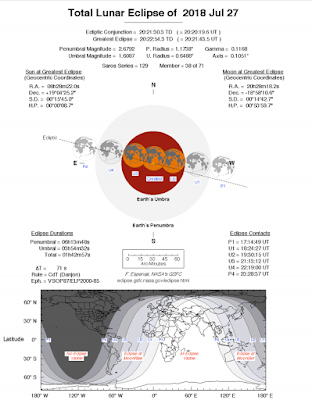
Total lunar eclipse of July 27, 2018
Timings and circumstances of the total lunar eclipse of July 27, 2018

Timings  of  the total lunar eclipse for Israel, with local Israel Daylight Times in parenthesis. In other words, the lunar eclipse begins at 9:24PM local time on Friday night, July 27, peak darkness is at 11:22PM on July 27, and ends at 1:19AM the morning of July 28.

2018 July 27
Partial eclipse begins: 18:24  UTC ( 21:24 Israel Daylight Time)
Total eclipse begins: 19:30  UTC (22:30 Israel Daylight Time)
Greatest eclipse: 20:22 UTC (23:22 Israel Daylight Time) 
Total eclipse ends: 21:13  UTC (00:13 Israel Daylight Time)
Partial eclipse ends: 22:19 UTC (01:19 Israel Daylight Time)
This is such a long eclipse because as you will note from the chart above, the moon passes almost directly through the very center of the earth's shadow, its widest part, spending the longest time of the 21st century in eclipse! This is also a Micromoon full moon, the opposite of a Supermoon. A Micromoon full moon occurs when the full moon is at apogee, its greatest distance from the earth, so it appears smaller in the sky. Hence it also spends more time in the earth's shadow. Aren't we lucky to be alive on this date and living in Israel for a front row seat!

Take some time while watching the eclipse to note the moon's darkness, called its Danjon Number during an eclipse. 0 is darkest, 5 is brightest. When the moon passes centrally through the  earth's shadow it's farthest from the edges of the shadow, so less sunlight gets refracted onto its surface during the eclipse.  During some very dark eclipses the moon may completely disappear. But this also depends alot on the earth's atmosphere at the time. The denser or cloudier it is around the globe the more sunlight gets refracted onto the moon and the brighter the eclipse. This is hard to predict so it should be fun to look for how dark this eclipse is and estimate its Danjon number. You can find out more about the Danjon Scale here.

All lunar eclipses occur during full moon, when the moon is opposite the sun with the earth in between. July 27th's eclipse falls out on the full moon of the Jewish month of Av, or Tu (meaning 15) B'Av, often referred to as Jewish Valentine's Day, since on this day in ancient times the girls used to dress in their finest and dance in the fields to encourage matches with the boys. A happy time after the fast and mourning of the 9th of Av, Tisha B'Av. So, what could be better than going out with your Bestie to enjoy the romance of the longest lunar eclipse of the 21st century? I will leave it to the astrologers if this is a good or bad omen, the eclipse of the light of love or its revelation in the darkness of the moon. In any case this should not be one of those famous "blood red" moon eclipses since it is so central in the earth's shadow and little refracted sunlight, which causes the red color, should be evident. In any case be sure to take in all the planets that will be visible during the night, and especially during the darkness of totality. (See our previous post on the summer planets.)

You need no optical aid to the view a lunar eclipse but even small binoculars enhance the view and will show you details on the moon that are otherwise invisible to the naked eye.

There are many events being held to view the lunar eclipse in Mitzpe Ramon, but since this is a Shabbat night we will not be holding our usual star tour. You can look those events up online  if you want to come down here. But a full moon and eclipse is usually so bright that you should be able to watch it from almost anywhere in Israel from the beaches of the Mediterranean to Diezengoff Square.
When I complained to a friend  that the longest lunar eclipse of the century was falling on Shabbat and I wouldn't be able to hold a star tour, he told me, "Relax, it's Gd's way of telling you to just enjoy yourself for once." And so I shall. I hope you do,too!

To find out more about this eclipse see here.


Sunday, January 21, 2018

Super Blue Blood Moon of Tu B'Shevat on January 31, 2018

There are alot of things, alot of colors going on here. Let's talk about what you're actually going to see.

In Israel, you are just going to see a full moon. It won't be blue; it won't be a blood red color. But because this full moon occurs when the moon is closest to earth in its orbit it will be bigger and brighter than usual, hence the term "supermoon". A supermoon is only 10%-15% bigger than a regular full moon but up to 30% brighter. Most experts will tell you that you can't see the difference unless you compare a supermoon in the sky to a regular full moon, which of course you can't do. But almost everyone, including me, who sees a supermoon feels it is much bigger than the last full moon they saw. Since a rising full moon looks bigger than usual when it's near the horizon anyway (called the "moon illusion"), most people strive to see a supermoon at moon rise to enhance the effect even more. A full moon always rises at sunset since it is opposite the sun (that's why it's full). In Israel this will be around 5:18pm on Wednesday, January 31, although the actual time will probably be anywhere from 15-30 minutes later since most people don't have a clear flat eastern horizon. Did I mention the moon will rise in the east, like all celestial bodies (you did know that, right?) So, you will need a clear eastern horizon. The full, supermoon will be in the sky all night long, you won't just see it at moon rise, but it will look biggest and brightest at moon rise due to the aforementioned "moon illusion".

Since this is the second full moon of January, it's called a "blue moon", although it never looks blue. The second full moon of a calendar month is called a "blue moon". The first one of this January was on January 1. It has come to refer to any event that occurs rarely, as a second full moon in a month is a relatively rare event. It occurs on average about every 2.72 years.

Now for the "blood moon". A blood moon is the name given to a moon in full eclipse, as it tends to look reddish during totality. This is because the earth acts like a lens and bends sunlight around itself to strike the moon during totality. This small amount of sunlight is filtered through the earth's atmosphere which makes the residual light falling on the moon red, just as the sun itself is reddened by the earth's atmosphere when it sets. You actually do see a reddish or "blood moon" during a total lunar eclipse, but sad to say, you won't in Israel, at least not this time. That's because totality ends before moon rise in Israel. You'll just see a regular, full, supermoon. No colors this time. Sorry. If you want o see the lunar eclipse on Wednesday you'll need to watch online. See the links below.

The best place for most of our readers to see the total lunar eclipse is in the wetern US. See times below. As you can see, the eclipse begins early in the morning on the east coast of the US with the moon setting in the west. It should make for a great photo opportunity! The west coast will get to see the entire even with totality beginning on the west coast at 4:52AM PST, again with the moon setting in the west.

Lunar eclipse times in the US on the morning of January 31, 2018


This is the first triple-header event since 1866: A super, blue blood moon. But wait! It gets better than that because this triple-header coincides this year with Tu B'Shevat, the 15th day of the Hebrew month of Shevat, known as the Birthday of Trees. It's the day that the age of trees is calculated from biblically for purposes of bringing tithes and offerings to the Temple and allowability to eat its fruits. (Fruits of tress are biblically prohibited until they are 4 years old, called "Orlah".) Of course, since it's the 15th of the month, it always coincides with a full moon, but I have no idea (and have not seen anyone else who does) when the last time Tu B'Shevat coincided with a super, blue, blood moon!

Unfortunately, the total lunar eclipse part of this event will not be visible in Israel. The western US will be the best place to see the lunar eclipse. (See above)


http://www.jewishpress.com/news/religion/get-ready-for-wednesdays-once-in-150-years-blood-moon-thats-also-super-moon-blue-moon-lunar-eclipse-and-tu-bshvat/2018/01/28/

NASA webcast of total lunar eclipse:
https://www.nasa.gov/press-release/nasa-television-to-air-live-coverage-of-upcoming-rare-lunar-eclipse

Other sites to watch the lunar eclipse online:
http://www.skyandtelescope.com/astronomy-news/where-to-watch-lunar-eclipse-online/

LinkWithin

Related Posts Plugin for WordPress, Blogger...